How to Lay Out a 32-Page Picture Book
In a printed picture book, page 1 is a single right-hand page, then pages pair up as two-page spreads (2 and 3, 4 and 5, and so on), and the last page of a 32-page book sits alone on the left. A common self-published layout puts the title on page 1, the copyright and dedication on page 2, starts the story on page 3, tells it across the 14 spreads from pages 4 to 31, and ends on page 32. KDP needs at least 24 pages and the interior uploaded as single pages, not spreads.
Before you write the final text or order art, map your picture book page by page. Knowing which pages face each other tells you where the title page goes, where the story can turn, and what your illustrator needs to draw. This guide has maps for 32 and 24 pages, how to plan page turns, how to make a paper dummy, and the Amazon KDP rules that affect your layout, checked in November 2026.
How pages pair up in a printed book
Page 1 is a right-hand page. Open the cover and page 1 sits alone on the right. From there, every even page is on the left and the odd page after it is on the right, so pages 2 and 3 face each other, then 4 and 5, and so on.
In a 32-page book, that gives you two single pages, page 1 and page 32, and fifteen two-page spreads, from pages 2 and 3 to pages 30 and 31. KDP doesn't print on the inside of the cover, so every one of those pages is in your interior file.
A 32-page map
- Page 1: title page, with the title, the author and the illustrator.
- Page 2: copyright page and dedication. They can share the page. See our copyright guide for what goes on it.
- Page 3: the story starts on a single right-hand page, often with one opening picture and the first line.
- Pages 4 to 31: fourteen spreads for the story.
- Page 32: the last page, for the final picture, "The End," or an about-the-author note.
Traditional publishers often use pages 1 to 5 for a half title, a title spread and a copyright page, which leaves 13 spreads for the story. Either works. For a first self-published book, the map above gives the story more room.
Where the story goes in those 14 spreads
One common way to split the story, by spread:
- Spreads 1 and 2 (pages 4 to 7): meet the main character and the problem.
- Spreads 3 to 10 (pages 8 to 23): the character tries to fix it, and each try goes a bit worse or gets a bit closer.
- Spreads 11 and 12 (pages 24 to 27): the worst moment, then the turn.
- Spreads 13 and 14 (pages 28 to 31): the problem is solved.
- Page 32: a last beat, like a small joke or a callback to page 3.
Our guide on how to write a children's book covers the story shape in more detail.
A 24-page map
KDP's paperback minimum is 24 pages, and many short picture books use it.
- Page 1: title page.
- Page 2: copyright and dedication.
- Page 3: the story starts.
- Pages 4 to 23: ten spreads for the story.
- Page 24: the ending.
Ten spreads is enough for a beginning, a problem, a few tries and an ending. Our guide to how long a children's book is has word counts to go with each length.
Planning page turns
The reader turns the page after every right-hand page. That makes the right-hand page the place for a question, a cliffhanger or a setup, and the next left-hand page the place for the answer.
Right-hand page: "Mia lifted the lid of the box, and out came..."
Turn the page: "...a very wet frog."
Keep the setup and the punchline on different spreads. If both are on the same spread, a child sees the picture of the frog before you read the line.
Make a paper dummy
A dummy is a rough mock-up of the book, and it's the fastest way to check your layout.
- Take eight sheets of printer paper for 32 pages, or six sheets for 24.
- Fold the stack in half and staple it on the fold.
- Number every page, starting with 1 on the first right-hand page.
- Write or tape your text onto each page and sketch a stick-figure picture.
- Read it aloud, turning the pages, the way you'd read it to a child.
You'll find pages with too many words, spreads where nothing happens, and turns that give the surprise away. Fix them on paper before anyone makes final art.
KDP rules that change your layout
- Page count: at least 24 pages for a paperback. Plan an even number, since every sheet has two sides.
- Single pages, not spreads: upload the interior as single pages. Split each spread illustration into its left and right halves.
- Bleed: for art that runs to the edge, each page of an 8.5 × 8.5 in book is 8.625 × 8.75 in. The 0.125 in of bleed goes on the top, bottom and outside edge, and none on the spine edge.
- Safe area: keep words and faces at least 0.375 in inside the trim on the outside edges, and at least 0.375 in from the spine edge for books of 24 to 150 pages.
- The middle of a spread: KDP paperbacks are glued at the spine, so the center of a spread curves into the binding. Keep faces and words away from the fold.
- Image quality: use pictures at 300 dpi at the printed size.
- The cover: a separate file with a spine width set by your page count. Our cover design guide explains it.
Tools for laying it out
The makeabook.fun maker works one page at a time and makes free KDP files: inside pages with bleed, padded to KDP's 24-page minimum, and a wraparound cover with the spine width worked out for you. If you'd rather design in Canva, our $5 KDP template has the bleed and safe area marked for 8.5 × 8.5 in pages and the cover.
Write & Self-Publish a Children's Book in 7 Days walks through putting text and art together in Canva, designing the cover and uploading to KDP. The free 7-day guide covers the same steps in short.
Common questions
How many spreads are in a 32-page picture book?
Fifteen: pages 2 and 3 through pages 30 and 31. Pages 1 and 32 are single pages. Once the title and copyright pages are in, the story usually gets 13 or 14 spreads.
Does the cover count as part of the 32 pages?
Not on a KDP paperback. The cover is a separate file, and KDP doesn't print on the inside of the cover, so all 32 pages are in your interior file.
Do I upload spreads or single pages to KDP?
Single pages. Split each spread illustration into a left page and a right page, and put the bleed on the outside edges.
What size is each page with bleed?
For an 8.5 × 8.5 in book, each interior page is 8.625 × 8.75 in. KDP adds 0.125 in of bleed to the top, bottom and outside edge, and none to the spine edge.
Is page 1 on the left or the right?
The right. When you open the cover, page 1 faces the blank inside of the front cover, so every odd page is a right-hand page.
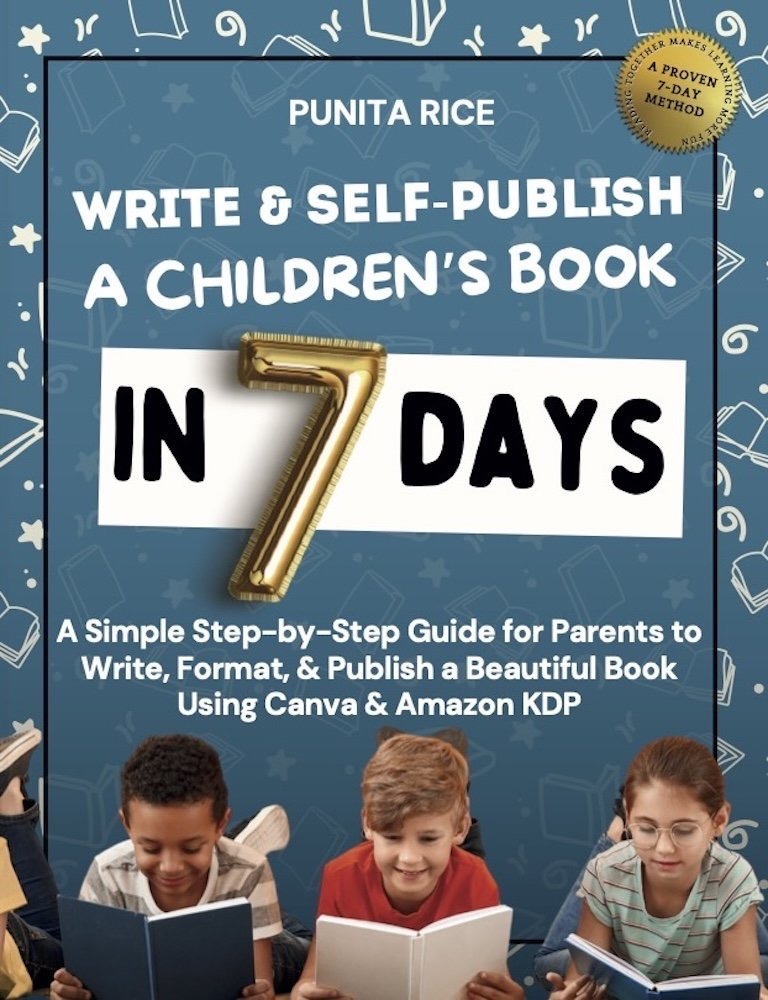
Write & Self-Publish a Children’s Book in 7 Days walks you through every step, including Amazon KDP. ★★★★★ 5.0 on Amazon.
Ready to make yours?
Make your bookOur 8.5 × 8.5 in Canva template for KDP costs $5 and has the bleed, margins and wraparound cover already set up.