Writing how-to
How to Write a Children's Book (Even If You've Never Written One)
Writing a children's book is less about fancy words and more about one clear story, told in a voice that sounds good out loud. If you're a parent writing for your own child or a first-timer with an idea you can't shake, here is a practical way to get from blank page to finished book.
Where do you get an idea for a children's book?
Start close to home. The best first books usually come from something real: a worry your child has, a funny thing they said, a big change coming up, a question they keep asking.
A few places to look:
- Big feelings. Being scared of the dark, jealous of a new baby, nervous about a new class.
- Milestones. A first lost tooth, learning to swim, moving to a new house.
- Everyday adventures. The trip to the grocery store, told as if it were an expedition.
- Your child's imagination. Ask them what should happen to a dragon who's afraid of birthday candles. Write down what they say.
Punita Rice, who wrote our book on self-publishing, made her oldest son a book about a bunny who was afraid of swim class after he got water in his eyes. It was a small, real moment, and years later he still pulls it out. Small and real is a great place to begin.
If you need more sparks, browse our list of children's book ideas.
What is the basic structure of a picture book?
Most picture books have a simple shape: one main character, one problem, a turn, and an ending.
- The beginning. Meet the character and their ordinary day. Keep it to a page or two.
- The problem. Something goes wrong, or something new arrives. This is the reason the story exists.
- The tries. The character tries to fix it, and it doesn't quite work. Two or three tries is plenty.
- The turn. Something changes. They find courage, a friend helps, they see the problem a new way.
- The ending. The problem is solved or feels smaller, and we see how life is now.
A handy tool for this is the story spine, a chain of sentence starters you fill in:
Once upon a time, there was ___. Every day, ___. But one day, ___. Because of that, ___. Because of that, ___. Until finally, ___. And ever since then, ___.
Fill in each blank with a sentence and you have a complete plot. Keep the problem focused. A picture book that tries to cover a new school, a new sibling and a lost pet all at once usually ends up covering none of them well.
One more tip: let the child character solve the problem. A grown-up can help, but kids love seeing someone their size do the brave or clever thing.
How long should a children's book be?
Shorter than you think. Picture books are usually brief, and many are under 1,000 words. The pictures carry a lot of the story, so the words don't have to describe everything.
For a book you're making for your own child, aim for one or two sentences per page. Picture books are commonly 24 or 32 pages, but a homemade book can be ten or twelve pages and feel complete. If you plan to print a paperback on Amazon KDP, it needs at least 24 pages; you can see how page count and trim size fit together in our guide to children's book sizes.
How do you write words that sound good read aloud?
A picture book is a performance. A grown-up reads it, often many times, and a child listens. Write for the ear.
- Use short sentences. If you run out of breath reading a sentence, split it.
- Choose concrete words. "The puddle was as big as a bathtub" beats "the puddle was very large."
- Repeat on purpose. A line that comes back ("But Milo still wasn't sure") gives kids something to say along with you.
- Use sounds. Splash, crunch, whoosh. Kids love saying them.
- Skip the rhyme if it fights you. A forced rhyme bends the story to fit the sound. Clear prose with a gentle rhythm works beautifully.
- Don't explain the pictures. If the drawing shows a red hat, the words don't need to say "she wore a red hat." Use the words for what the picture can't show, like what a character is thinking.
What are page turns and why do they matter?
A page turn is a tiny pause, and good picture books use it. The reader turns the page to find out what happens, which builds a little suspense even in a simple story.
When you split your text into pages, look for moments to end a page on a question or a cliffhanger:
Rosie opened the closet door very, very slowly, and inside she saw...
Then the answer lands on the next page. Save your biggest reveal, the turn in the story, for a page turn. A page of just words or just one big picture can also slow things down at a quiet moment.
A simple way to plan this: write each page's text on its own sticky note or line, then move them around until each page ends somewhere that makes you want to keep reading.
How do you revise a children's book?
Read it aloud. Then read it aloud again. This is the most useful revision step there is.
- Read it to yourself, out loud. Mark every spot where you stumble, and smooth it out.
- Cut what the pictures can show. Most first drafts have too many words. Try removing a sentence from each page and see if anything is lost.
- Check the problem and the ending. Is the problem clear by the third or fourth page? Does the ending answer it?
- Read it to a child. Watch where they lean in and where they wiggle. Wiggles usually mean a page is too long.
- Let it sit a day. Fresh eyes catch things tired ones miss.
How to turn your story into a book with makeabook.fun
Once you have words, you can make the actual book for free in your browser, with no sign-up.
- Open the maker. The "A story about them" starter pre-fills pages with story spine prompts, so you can type your story right into the shape above. Prefer to start from scratch? Use a blank book with twelve empty pages.
- Put one or two sentences on each page. Rearrange until your page turns land where you want them.
- Add pictures. Upload photos, phone photos of your child's drawings, or sketch on the built-in drawing pad with a finger, mouse or stylus.
- Pick layouts. Six page layouts include words below a picture, words on a big picture, and pages of just words or just a picture for those quiet moments.
- Choose a font. Andika is designed for children learning to read, a nice choice if your child will read it on their own.
- Make the cover. Add a title, subtitle and your name as author, plus a back cover blurb. The title page and dedication page fill themselves in.
- Read it in the flip-through reader. This is a great time for one more read-aloud.
Your book saves in your browser on that device, and nothing is uploaded. When you're ready, download the free print-at-home PDF, the $2.99 keepsake edition with a fold-and-staple booklet layout, or free Amazon KDP files. Our guide to printing a picture book at home covers paper and printer settings.
If you're writing about your own child, you may also like our guide to making a personalized children's book.
Going further: self-publishing your book
If you want to take your story all the way to a paperback on Amazon, Write & Self-Publish a Children's Book in 7 Days by Punita Rice walks through brainstorming, writing, making art, putting it together in Canva, designing a cover and uploading to Amazon KDP. Our free 7-day guide and fiction and nonfiction planning templates are a good place to start.
Questions parents ask
How many words should a children's picture book have?
Picture books are usually short, and many are under 1,000 words. For a homemade book, one or two sentences per page is plenty.
How many pages is a children's picture book?
Picture books are commonly 24 or 32 pages. A book you make for your own child can be shorter; ten to fifteen pages is a comfortable first book.
Do I need to be able to draw to write a children's book?
No. You can use photos, your child's drawings, or simple doodles on the makeabook.fun drawing pad. Many parents write the words and let their child make the art.
Does a children's book have to rhyme?
No. Rhyme is hard to do well, and forced rhymes can bend a story out of shape. Clear, simple sentences with a nice rhythm read aloud beautifully.
Can I make my children's book into a real paperback?
Yes. The makeabook.fun maker gives you free Amazon KDP files: inside pages with bleed, padded to the 24-page minimum, and a wraparound cover with the spine width calculated for you.
Ready to make yours?
Free, right in your browser. Pick a story starter, add pictures, and print it at home.
Start writing your story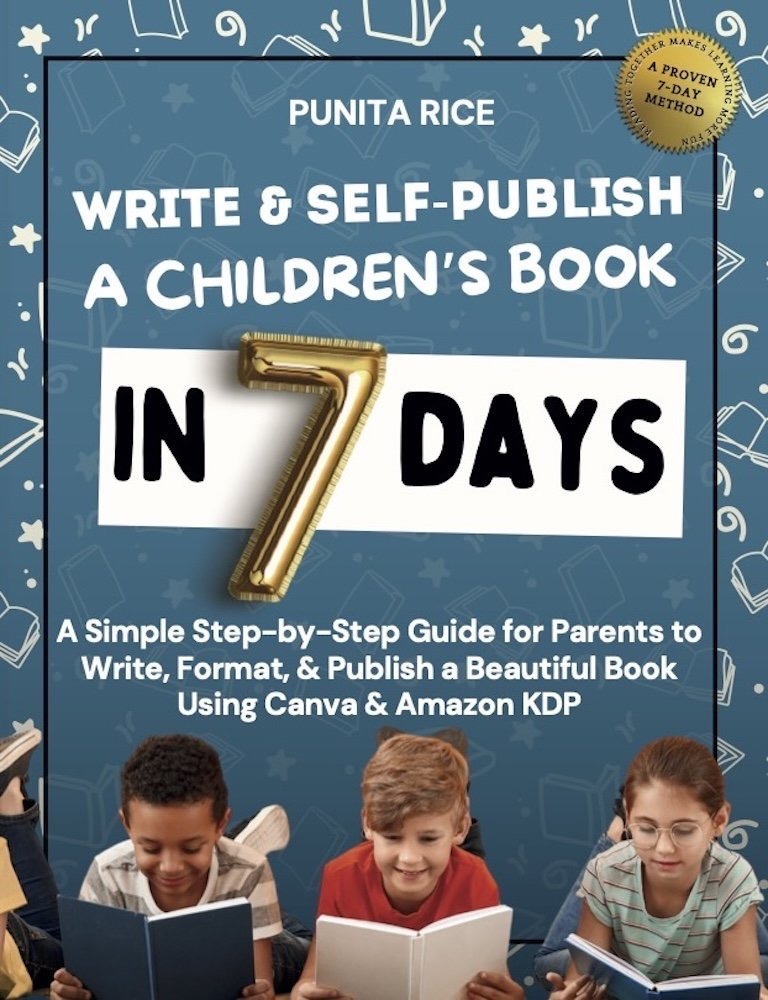
Write & Self-Publish a Children’s Book in 7 Days walks you through every step, including Amazon KDP. ★★★★★ 5.0 on Amazon.
Get the book →