First flight
How to Make an Airplane Social Story for Your Child's First Flight
An airplane social story is a short, first-person book that walks a child through a flight step by step: packing their bag, the airport, security, waiting at the gate, boarding, buckling the seat belt, takeoff sounds, ears popping and landing. Reading it before the trip helps them know what to expect. You can make one free at makeabook.fun with your own photos.
An airplane social story is a short picture book, told in your child's own voice, that walks through a flight one step at a time: packing a bag, going through the airport, security, the gate, boarding, takeoff and landing. A personalized one uses your child's name, their real backpack and the trip you are actually taking, so the airport is a place they have already "visited" in a book before they arrive.
What is an airplane social story?
An airplane social story is a type of social story: a short, personalized story that explains a situation, what usually happens, and what the child can do. The format was developed by Carol Gray. Social stories are written in first person and present tense, and they describe more than they direct. Our full guide to how to write a social story explains the approach in detail.
A first flight has a lot of new noises, lines and rules packed into one day. Breaking it into one step per page makes it much easier to follow.
What should a first flight book include?
Include every step your child will actually see, in order, plus what they can do at the tricky moments. Most airplane social stories cover these eight things:
- Packing their own bag. What goes in it: a snack, a book, a comfort toy, headphones.
- Getting to the airport. The car, train or shuttle, and how big and busy the airport is.
- Security. Bags go in a bin on a moving belt, and we walk through a doorway one at a time. A worker might look in a bag.
- Waiting at the gate. Big windows, airplanes outside, and waiting until it is our turn.
- Boarding and finding the seat. Walking down the hallway onto the plane, finding the row, and putting the bag under the seat.
- The seat belt. Buckling up, keeping it on when the light is on, and listening to the flight attendants.
- Takeoff and landing. Loud engine sounds, the plane going fast, ears feeling full or popping, and what helps.
- Arriving. Getting off the plane, picking up bags, and who is waiting for us.
Security steps and airport layouts vary, so keep this section general and use "usually" rather than promising exact details.
A page-by-page outline you can copy
This 15-page outline is written in first person, like a classic social story. Fill in the brackets with your real trip.
- Cover: "[Name] Flies on an Airplane", with a photo of your child holding their backpack.
- The trip: "My name is [Name]. Soon I am going on an airplane to visit [Grandma] in [city]."
- Packing: "I pack my own bag. I put in [my bunny], [a snack] and [my headphones]."
- Going to the airport: "We go to the airport in [the car]. The airport is big and busy, and there are lots of people."
- Checking in: "Sometimes we give our big suitcase to the airline. We usually get it back after the flight."
- Security: "At security, we wait in a line. My bag goes in a bin on a moving belt. I walk through a doorway when the worker says it is my turn."
- After security: "My bag comes out at the other end. I can take [my bunny] back."
- The gate: "We wait at the gate. I can see airplanes through the big windows. Waiting can take a while, so I can [read my book] or [have a snack]."
- Boarding: "When it is our turn, we walk down a long hallway onto the airplane."
- My seat: "I find my seat. My bag goes under the seat in front of me."
- Seat belt: "I buckle my seat belt. The flight attendants help keep everyone safe. I listen to them."
- Takeoff: "The engines get loud and the plane goes fast. Then it goes up into the sky. I can hold [Mommy's] hand."
- In the air: "My ears might feel full or pop. I can swallow, sip my drink or yawn. Then I can [watch a show] or [color]."
- Landing: "The plane comes down and bumps a little on the ground. I stay buckled until the light goes off."
- We made it: "We get off the plane. [Grandma] is waiting for me. I flew on an airplane."
Words that help for the hardest pages
Security, loud noises and waiting are where most worries show up. Use calm, literal sentences in first person, and offer a choice of things your child can do.
At security, a worker might look inside my bag. That is their job. My things will come back to me.
When the airplane goes up, it is loud. Loud is OK. I can cover my ears, wear my headphones or squeeze [Daddy's] hand.
Sometimes the airplane is late and we have to wait longer. Waiting is hard. I can [read], [play I spy] or [have my snack] while we wait.
When and how should I read it?
Start reading the story a week or two before the trip, a few times a week, and bring a copy along. Reading the next page right before each step turns the book into a map for the day.
- Practice at home: act out the pages. Put a bag in a laundry basket "bin", walk through a doorway, buckle a belt on a chair.
- Let your child pack the bag on the packing page, then take a photo of it for the book.
- At the airport: open to the step you are on and say, "Look, this is the page we are on now."
- After the trip: swap in real photos from the airport and plane, and keep it for the flight home or the next trip.
If your child has an IEP, therapist or specific medical needs, follow their guidance for travel. This book is a way to explain what to expect, not therapy or medical advice.
How to make it on makeabook.fun
makeabook.fun is a free picture-book maker that runs in your browser, with no sign-up.
- Open a blank book. Go to "A blank book", which gives you twelve empty pages. Add a few more for the full outline.
- Pick a size. Square (8.5 × 8.5 in) works well. A Wide book (10 × 8 in) suits airplane photos taken through a window.
- Write one step per page. Use the outline above in first person.
- Add photos. Upload pictures of your child's bag, their seat belt practice, or the real airport, then drag and zoom to frame them.
- Use the drawing pad. Your child can draw the airplane, clouds or the person waiting at the other end with a finger, mouse or stylus.
- Pick a clear font and layout. Andika is designed for children learning to read, and "picture with words below" keeps each step easy to follow.
- Preview it in the flip-through reader and download the free PDF.
For other first-time experiences, see our dentist social story and haircut social story.
Printing it for the trip
The free full-color print-at-home PDF fits each page on US Letter or A4 paper; our guide to how to print a picture book at home covers paper and binding. For a book that rides in a backpack, the Keepsake edition ($2.99 once per book) adds print-shop quality at the exact size, no makeabook.fun mark, a compact fold-and-staple booklet, and free re-downloads after you add the real trip photos.
Questions parents ask
How far ahead should I read an airplane social story?
Start about a week or two before the trip and read it a few times. Bring it on the trip too, so you can read the next page while you wait at each step.
What if I don't have photos of the airport?
Use your child's drawings, simple photos of their own suitcase and seat belt at home, or pictures you take on the way. Many families add real airport photos afterward and keep the book for the next flight.
What can help with ears popping on a plane?
Swallowing, sipping a drink, chewing or yawning during takeoff and landing often helps ears feel better. For babies or children with ear problems, ask your pediatrician before you fly.
Should the story promise that everything will go smoothly?
No. Use words like usually and sometimes, so a delay or a different gate does not feel like the story was wrong. Include a page about waiting and what your child can do then.
Is a social story a kind of therapy?
No. It is a simple way to explain what usually happens. If your child works with a teacher or therapist, follow their guidance and ask if they have tips for travel.
Ready to make yours?
Free, right in your browser. Pick a story starter, add pictures, and print it at home.
Start a flight story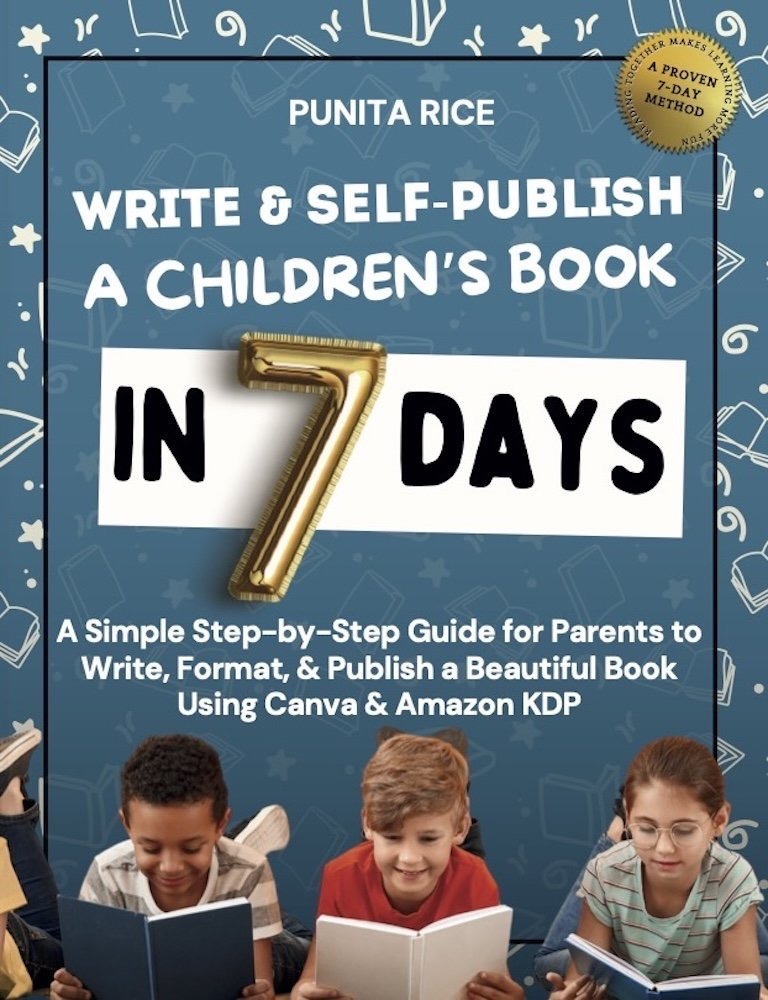
Write & Self-Publish a Children’s Book in 7 Days walks you through every step, including Amazon KDP. ★★★★★ 5.0 on Amazon.
Punita Rice made The Adventures of Hunny & Sunny, picture books about two bunny brothers who face their fears, find funny words and explore the solar system, for her own kids.
Meet Hunny & Sunny ↗