Potty training
How to Make a Personalized Potty Training Book for Your Child
A personalized potty training book is a short picture book that shows your own child using the potty, step by step: noticing the feeling, going to the bathroom, pants down, sitting, wiping, flushing and washing hands. It says accidents are OK and ends with a celebration. Using photos of their real bathroom helps. You can make one free at makeabook.fun.
A personalized potty training book is a short picture book that shows your child, by name, learning to use the potty one small step at a time. It walks through the real routine in your real bathroom, says plainly that accidents are part of learning, and ends with a happy celebration. Because the hero is your child, the book becomes a picture of what they are about to do, not a story about someone else.
Why make a potty training book about your own child?
A homemade potty book shows your child the exact potty, bathroom and routine they will use, so there is nothing to translate from a cartoon character to real life. That matters for toddlers, who learn best from things that look like their own world.
It also lets you match your family's choices. If you use a small potty first, a seat on the big toilet, a step stool, a special song, or a sticker chart, the book can show exactly that. Store-bought books can't know which words you use, either. Your book can say "pee and poop", "potty", "toilet" or whatever your family says.
We write these as simple social-story-style books: first person, present tense, short sentences. If that format is new to you, our guide on how to write a social story explains it.
What should a potty training book include?
A good potty book covers the whole routine in order, with one step per page. Most include these parts:
- Who is learning. Your child's name and photo, and that they are getting bigger.
- The new things. Their potty or toilet seat, the step stool, the underwear they picked.
- Noticing the feeling. What it can feel like when pee or poop is coming, and that it is time to go.
- The steps. Walk to the bathroom, pants down, sit, go, wipe, pants up, flush, wash hands.
- Waiting is OK. Sometimes nothing comes right away, and that's fine.
- Accidents are OK. We clean up together and try again. Nobody is in trouble.
- Going out. Potties at school, at Grandma's, or at the store, if that is part of your plan.
- Celebrating. A high five, a sticker, a happy dance, a call to a grandparent.
A page-by-page outline you can copy
Here is a 14-page outline. Replace the words in brackets, use your family's words for body parts and bathroom things, and cut any page you don't need.
- Cover: "[Name] Uses the Potty", with a proud photo of your child.
- This is me: "I am [Name]. I am [age]. I am learning to use the potty."
- My potty: "This is my [potty / seat on the big toilet]. It is in our [bathroom upstairs]." Use a photo of the real one.
- My big kid underwear: "I picked my underwear with [dinosaurs / stars] on it. I can keep it dry."
- The feeling: "Sometimes my tummy feels [full / wiggly]. That means pee or poop is coming."
- I go to the bathroom: "When I feel it, I stop playing and go to the bathroom. I can tell [Mommy / Daddy / my teacher]."
- Pants down: "I pull my pants and underwear down."
- I sit: "I sit on my potty. I can [read a book / sing our potty song] while I wait."
- Pee and poop go in the potty: "My pee and poop go in the potty. That's where they belong."
- Wipe: "I wipe with toilet paper. [Daddy] helps me if I need it."
- Flush: "I flush. The toilet is loud, and that's OK. I can cover my ears." (If your child uses a small potty, show how you empty it together.)
- Wash hands: "I stand on my stool and wash my hands with soap and water. I sing [our song] while I scrub."
- Accidents happen: "Sometimes I have an accident. That's OK. We clean up and I try again next time."
- Celebrate: "I used the potty. [We do a happy dance / I get a sticker]. I am proud of me."
If your child goes to daycare, add a page with a photo of the school bathroom (ask the teacher first) so the steps look the same in both places. If you are also working on giving up a pacifier or moving to a big kid bed, keep those in separate books so each one stays simple.
Words that help on the hard pages
The accident page and the "waiting" page are the ones that matter most. Keep them calm, kind and specific. You could use sentences like these:
Sometimes I sit and nothing comes. That's OK. I can try again later.
Sometimes pee comes out before I get to the potty. That's called an accident. Accidents happen when we are learning. I am not in trouble.
After an accident, I help put my wet clothes in the laundry. I put on dry underwear. Next time, I will try to go to the potty.
If I feel scared of the big toilet, I can hold [Mommy's] hand.
When and how should I read a potty training book?
Start reading it a week or two before you begin potty training, then keep it in the bathroom while you train. Toddlers get comfortable with new things by hearing about them many times.
- Before you start: read it once a day, at a calm time. Let your child point to each step in the photos.
- During training: read a page or two while they sit on the potty. It gives them something to do while they wait.
- After an accident: later, when everyone is calm, read the accident page together. It reminds both of you that this is normal.
- When it clicks: add a new last page with a photo of the celebration, and print a fresh copy.
Every child learns on their own timeline. If you have questions about readiness or worries about toileting, your pediatrician is the right person to ask.
How to make a potty book on makeabook.fun
makeabook.fun is a free picture-book maker that runs in your browser on a phone, tablet or computer, with no sign-up.
- Open a blank book. Start with "A blank book", which gives you twelve empty pages. Add or remove pages to fit the outline above.
- Take your photos. Photograph the potty, the step stool, the sink, the underwear and the toilet paper. You don't need to photograph your child on the potty: a photo of them smiling in the hallway works for the cover.
- Add one step per page. Upload a photo, then drag to reposition and zoom so the important thing is in the middle. "Picture with words below" is a good layout for most pages.
- Let your child draw. On the built-in drawing pad they can draw with a finger, mouse or stylus, or add stars and smiles over a photo of the potty.
- Pick a readable font. Andika, a font designed for children learning to read, keeps the words clear.
- Finish the cover. Add the title and your child's name. The title page and dedication page fill themselves in.
- Read it in the flip-through reader, then print.
Printing a potty book that can live in the bathroom
The free print-at-home PDF prints in full color, each page centered on US Letter or A4 paper with small corner trim marks. A bathroom book gets handled a lot, so the Keepsake edition ($2.99 once per book) can be worth it: print-shop quality at the exact book size, no makeabook.fun mark, and a fold-and-staple booklet layout, with free re-downloads when you add that celebration page. Our guide on how to print a picture book at home covers paper and binding, and if you'd like ideas for the next one, try a bedtime routine book.
Questions parents ask
When should I start reading a potty training book?
A week or two before you start is a good time, so the steps feel familiar. Keep reading it during training too, especially before tries on the potty.
Should the book be about my child or a character?
A book about your own child, with photos of their real potty and bathroom, shows them exactly what to do in the place they will do it. Toddlers often love seeing themselves as the one who can do it.
What should the book say about accidents?
Keep it calm and simple: accidents happen, everyone is still learning, we clean up and try again next time. Avoid any words that sound like a punishment.
How many pages should a potty book have?
Ten to fourteen short pages is plenty for a toddler. One step per page with a photo keeps it easy to follow.
Are the photos in my potty book private?
Yes. Books save in your browser on that device and nothing is uploaded, so we never see your photos. You can photograph the potty and bathroom without showing your child at all.
Ready to make yours?
Free, right in your browser. Pick a story starter, add pictures, and print it at home.
Start a potty book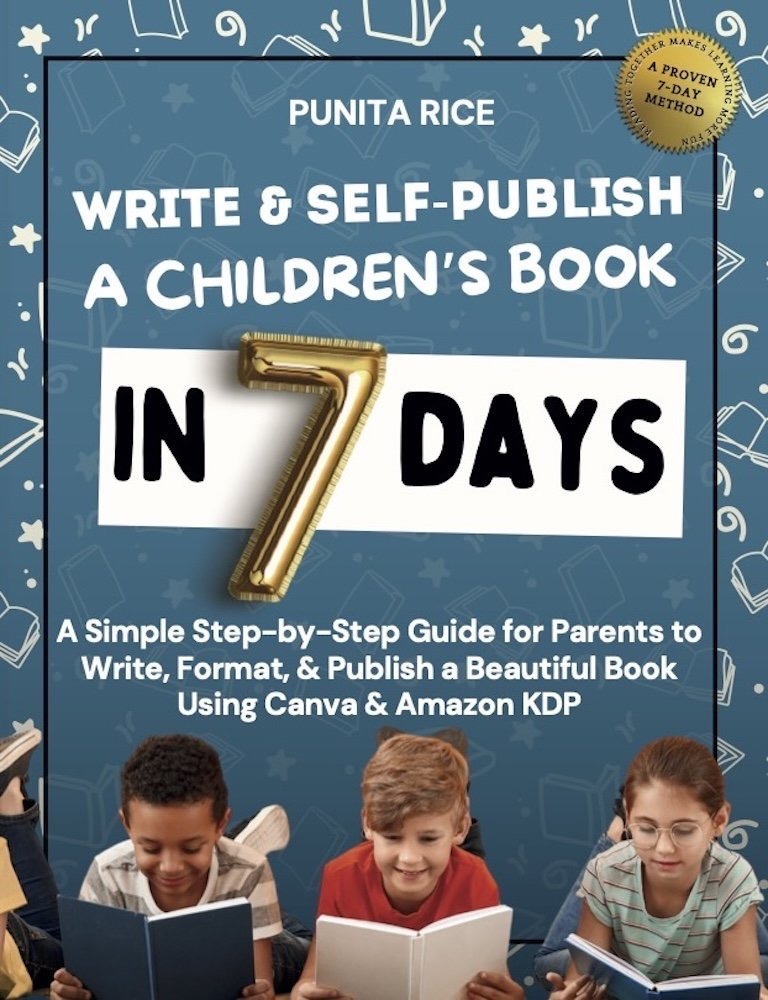
Write & Self-Publish a Children’s Book in 7 Days walks you through every step, including Amazon KDP. ★★★★★ 5.0 on Amazon.
Punita Rice made The Adventures of Hunny & Sunny, picture books about two bunny brothers who face their fears, find funny words and explore the solar system, for her own kids.
Meet Hunny & Sunny ↗